


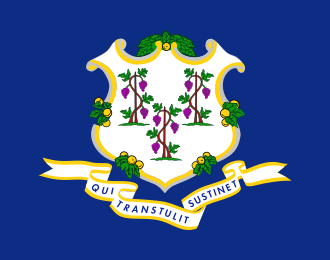
Connecticut State Authority
Connecticut State Authority is home to 3,624,508 residents with median household income $95,781.
Explore Connecticut State Authority by County
Click any county to visit its landing page.
Connecticut State: What It Is and Why It Matters
Connecticut is the third-smallest state by land area in the United States — 5,543 square miles — and yet it consistently ranks among the most economically dense, institutionally complex, and historically layered jurisdictions in the country. This page establishes what Connecticut is as a governmental and geographic entity, what falls within its authority, and how its structures connect to the broader American federal framework. From county governance to state agency operations, this site covers 84 in-depth pages on Connecticut's government, geography, demographics, law, and public services.
Scope and definition
Connecticut is one of the original 13 states, admitted to the Union under the U.S. Constitution in January 1788 — the fifth state to ratify. It sits in the northeastern corner of the continental United States, bordered by Massachusetts to the north, Rhode Island to the east, New York to the west, and Long Island Sound to the south. The state capital is Hartford, which has held that designation since 1875.
The state's governing framework derives from the Connecticut State Constitution, which was adopted in 1965 and replaced an amended version dating to 1818. That foundational document structures three branches of government: a bicameral legislature known as the Connecticut General Assembly — composed of a 36-member Senate and a 151-member House of Representatives — an executive branch headed by the Governor, and a unified judicial branch. The Connecticut Governor's Office holds authority over state agencies, the state budget, and executive orders, while the Connecticut Judicial Branch administers the court system from the Supreme Court down to the probate level.
The state is divided into 8 counties, though Connecticut abolished county government as a functioning administrative layer in 1960. The counties persist as geographic and judicial districts — not as self-governing entities with budgets or elected officials. This is a detail that trips up nearly everyone who moves here from a state where county government is a primary point of service delivery.
What qualifies and what does not
What falls within Connecticut's state authority:
-
Legislation enacted by the General Assembly and codified in the Connecticut General Statutes
-
Regulatory enforcement through executive agencies including the Connecticut Department of Public Health, the Connecticut Department of Labor, and the Connecticut Department of Energy and Environmental Protection
-
State taxation administered by the Connecticut Department of Revenue Services, including the state income tax, sales tax, and estate tax
-
Public education policy through the Connecticut Department of Education, which oversees 166 local school districts
-
Infrastructure, transportation, and land use through agencies such as the Connecticut Department of Transportation
-
Municipal governance — Connecticut's 169 towns and cities operate under state-granted authority, not independently sovereign power
What does not fall within this scope:
Federal law, regulation, and programs — including Social Security, Medicare, and federal civil rights enforcement — operate parallel to but not through Connecticut state authority. Tribal nations within Connecticut's borders, including the Mashantucket Pequot Tribal Nation and the Mohegan Tribe, hold sovereign status recognized by the federal government and are not subject to state jurisdiction in the same manner as municipalities. Interstate compacts, federal court jurisdiction, and U.S. Congressional representation involve Connecticut's federal delegation but are governed at the national level. This site does not cover federal law or agencies except where they intersect directly with Connecticut state operations.
Primary applications and contexts
The practical reality of Connecticut state government touches residents at a granular level — often more directly than federal structures do. Property tax, school funding, zoning, building permits, business licensing, drivers' licenses, and voting registration all flow through state-chartered institutions, most of them operating at the municipal level under state law.
The Connecticut Counties Overview page on this site maps that geographic structure in detail. Each county has its own character: Fairfield County anchors the southwestern corner with the densest concentration of corporate headquarters and the highest median household incomes in the state; Hartford County hosts the capital city and the insurance industry that built it; New Haven County contains Yale University and the state's second-largest city. Moving northwest, Litchfield County is the state's most rural, covering 945 square miles with a population density that would feel familiar in Vermont. Middlesex County sits at the geographic heart of the state, straddling the Connecticut River corridor.
For questions about how all of this fits together, the Connecticut State Frequently Asked Questions page addresses the most common points of confusion about jurisdiction, services, and state structure.
The Connecticut Government Authority provides in-depth coverage of Connecticut's public institutions, elected offices, and regulatory agencies — a substantive resource for anyone navigating the operational side of state government, from agency mandates to legislative processes.
How this connects to the broader framework
Connecticut operates as one of 50 states within the U.S. federal system, which means its authority is both broad within state matters and bounded by the Supremacy Clause of the U.S. Constitution. The broader network context for this site sits within United States Authority, which serves as the national hub connecting state-level authority sites across all 50 states.
Within that federal architecture, Connecticut has some notable structural distinctions. It is one of 4 states that officially uses the term "commonwealth" in some historical contexts but is legally designated a state. It has no county-level government, placing it alongside Rhode Island as one of only 2 New England states where municipalities are the primary unit of local governance. Its 169 towns include both urban cities and rural townships, all operating under the same basic legal framework established in Title 7 of the Connecticut General Statutes.
The state's economic profile — a GDP exceeding $280 billion as of 2022 (U.S. Bureau of Economic Analysis) — reflects an economy built on financial services, aerospace and defense manufacturing, healthcare, and higher education. That economic complexity generates the regulatory and institutional density that makes understanding Connecticut's governmental structure genuinely useful, not merely academic.
Connecticut Counties — Interactive Map
Click any county to view its full reference page.
Connecticut county map
Browse Counties
- Tolland County (13,502)
- New Haven County (12,359)
- Fairfield County (7,103)
- Litchfield County (7,074)
- New London County (3,189)
- Hartford County (2,851)
- Middlesex County (1,815)
- Windham County (1,045)
All Counties
Top Employers — Statewide
Data from state economic-development agency. Source: https://www1.ctdol.state.ct.us/lmi/EmpSearchTopList.asp?intAreaType=3&intArea=3&IntTopEmployer=100
-
Affirmative Action Plan
-
Business Consultants
-
Connecticut Employer Search
-
Help Wanted OnLine
-
Occupational Projections
-
OEWS Occupational Wages
-
New Hire Reporting
Federal Disaster Declarations (30)
Source: FEMA OpenFEMA v2 DisasterDeclarationsSummaries
Codes & laws coverage
State statutes & administrative code
10 / 10
categories with corpus rows (100% of applicable) · known: Agency Guidance, Attorney General Opinions, Constitution & Foundation, Court Decisions, Federal Notices & Orders (+5 more) · full breakdown →
Laws & Codes
Live from our ingestion pipeline; new content appears within minutes of fetch.
- RCSA § 10-287c-32 Sec. 10-287c-32. Record Retention Applicants shall maintain all records necessary to evidence conformity with chapter 173 of the Connecticut · source
- RCSA § 10-287c-33 Regulations of Connecticut State Agencies Sec. 10-287c-33. Miscellaneous (a) Portable, Relocatable or Demountable Buildings Where a town or · source
- RCSA § 10-287c-28 Regulations of Connecticut State Agencies Sec. 10-287c-28. Eligible Costs (a) Eligible costs for a school building project shall include: (1 · source
- RCSA § 10-287c-29 Sec. 10-287c-29. State Standard Space Specifications (a) The Department shall determine the state standard space specification for each scho · source
- RCSA § 10-287c-31 Sec. 10-287c-31. Grant Payments/Reimbursement (a) Grant Payments. · source
- RCSA § 10-287c-27 Sec. 10-287c-27. Grant Computation (a) Pursuant to Chapter 173 of the Connecticut General Statutes and sections 10-287c-1 to 10-287c-33, inc · source
- RCSA § 10-287c-26 Sec. 10-287c-26. Plan Review (a) Design Conference Except for school building projects reviewed and approved by local officials pursuant to · source
- RCSA § 10-287c-30 Sec. 10-287c-30. Allowable Cost Per Square Foot For applications submitted on and after July 1, 2026, the maximum allowable cost per square · source
- RCSA § 10-287c-25 Regulations of Connecticut State Agencies Sec. 10-287c-25. Grant Commitments (a) Grant Commitments The Commissioner shall not issue a commit · source
- RCSA § 10-287c-24 Regulations of Connecticut State Agencies Sec. 10-287c-24. Applications for Grants An application for a grant under chapter 173 of the Conne · source